Rooftop solar owners have to pay a fixed daily energy supply charge regardless of how much grid energy they use or export.
It should be prorated to grid use, but it has become the goose that laid the golden egg, accounting for nearly half the overall electricity cost.
The daily energy supply charge is not as regulated as the cost of energy and has steadily been rising from between 10-20 cents in 2020 to between $1 and as high as $2.84 in 2025 (NSW source). It is the same amount as those without rooftop solar.
The lower end daily energy supply charge usually relates to users on Time-of-Use tariffs (peak, shoulder, off-peak and seasonal). The higher daily supply charge usually refers to Demand tariffs, fixed tariffs (same price per 24 hours) and free electricity offers (sometimes linked to EV charging or pool filters).
A higher daily energy supply charge also affects solar feed-in tariffs (FIT). The more you pay per day, the higher your FIT. Although that is now a measly <4 cents per kWh, and some States charge a Sun tax and rooftop solar feed-in tariffs to reduce again.
Bottom line, at least for Ausgrid NSW, you will pay about $450 ($1.25 per day) and up to $1,036.60 ($2.84 per day) regardless of how much energy you feed in. And you cannot go off-grid because, legally, if it’s possible to connect to the grid, you must.

This is grossly unfair. Compare this to EV owners not having to pay the Government fuel excise of 51.6 cents per litre (free road use), getting FBT and Luxury Car tax breaks, home charging station subsidies and more perks to encourage EV use.
Why the daily energy supply charge rip-off?
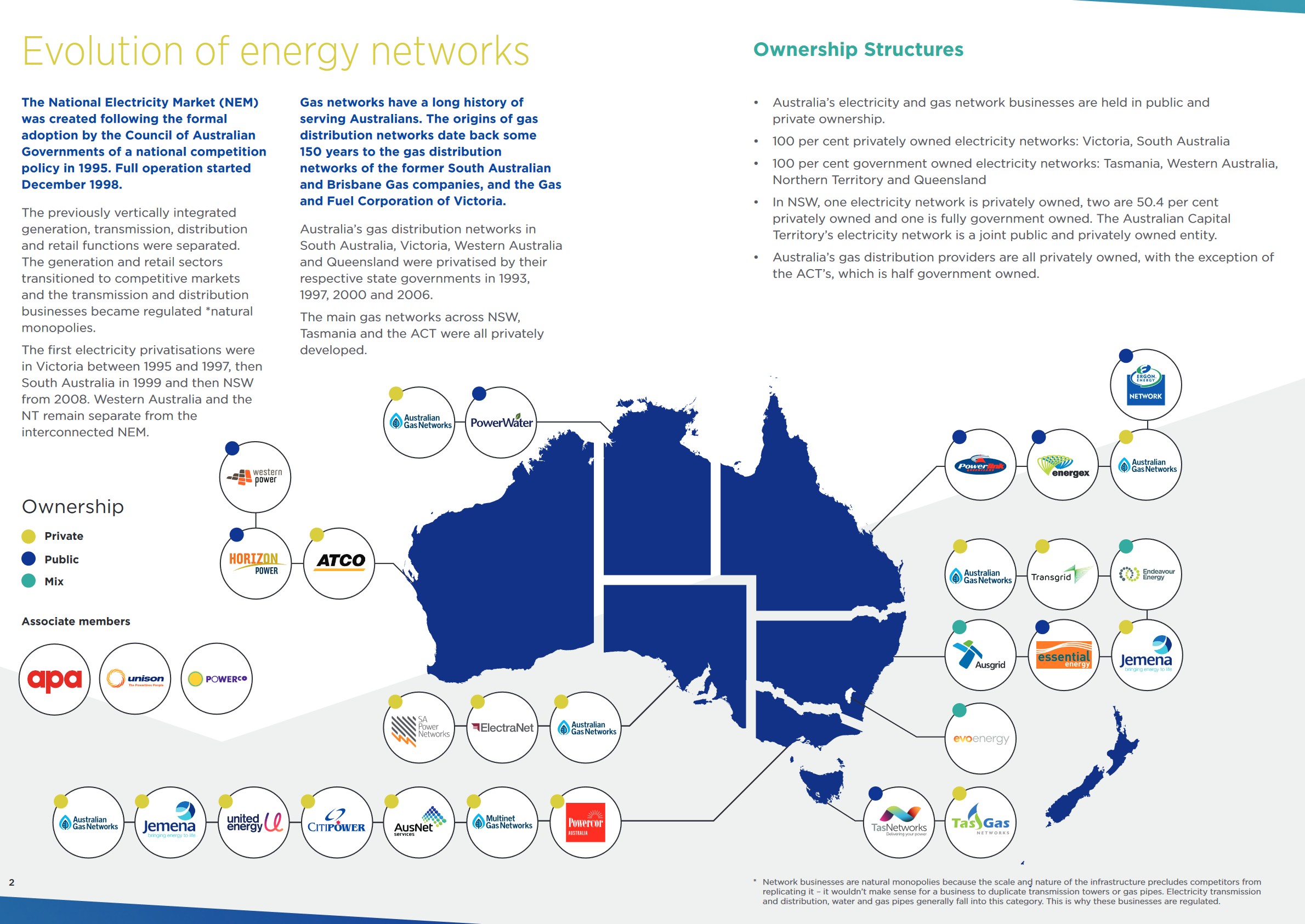
To a considerable degree, it is because NSW, Victoria and South Australia sold the silverware (poles and wires) to private companies that exist for the benefit of shareholders (Source). Many are foreign companies.
- EnergyAustralia is owned by China Light and Power (China)
- Cheung Kong Infrastructure/Power Assets owns a 51% share in both CitiPower Electricity Distribution Network Victoria and Powercor Electricity Distribution Network Victoria (China).
- Cheung Kong Infrastructure owns a 50% share in the transmission link, which transports renewable energy from the Mt Mercer wind farm to the Victorian grid (China).
- Cheung Kong Infrastructure/Power Assets owns a 51% share, on a 200-year lease, in SA Power Networks’ Electricity Distribution network (China)
- A 99-year lease of electricity transmitter TransGrid to a consortium comprising Canadian, Middle Eastern and local investors.
- ENGIE and Simply Energy are 100% foreign-owned (French)
- Energy Australia is owned by CPL (China)
- Jemena is owned by 60% China’s State Grid Corporation and 40% Singapore Power (China)
- ActewAGL is 50% owned by Jemena (China)
- Jemena Electricity Distribution Victoria owns 34% of United Energy Electricity Distribution Victoria (China).
- Nectr is owned by Hanwha Energy (South Korea)
- OVO Energy has substantial UK interests and AGL
- Powershop (Shell multinational)
- Tango is owned by China’s State Power Investment Corporation (China)
- Chow Tai Fook Enterprises owns Alinta Energy (not mentioned on its website), which rivals Origin Energy and AGL Energy for size. It owns Pinjarra Power Station, Western Australia; Wagerup Power Station, Western Australia; Yandin Wind Farm, Western Australia; Braemar Power Station, Queensland; Bairnsdale Power Station, Victoria; Loy Yang B Power Station; Victoria; Glenbrook Power Station, New Zealand; Reeves Plains Power Station, a new gas-turbine power station in South Australia
The majority of energy retailers (excluding the big three) are privately owned (click on the image to enlarge).
The renewables push has placed an extraordinary strain on the poles and wires. The Australian Energy Market Operator’s ‘Integrated System Plan’ advocates a coordinated approach to the development of transmission infrastructure to support lower emissions (Paris Accord, which means depreciating or eliminating lower-cost coal-fired power) and generation (renewables, roof-top solar, solar farms, wind, and gas) to meet customer demand.
In layman’s terms, it is a bloody lot of taxpayers’ money when there are many other alternatives, like more realistic net-zero time frames and using the money instead for community batteries (a global solution that immediately works). Read Solar Sharer – Will it help anyone?
I’mTech’s insight: the daily energy supply charge rip-off for rooftop solar owners
I have been closely monitoring my grid dependence after installing rooftop solar, and frankly, it is now down from 22% to between 2 and 5% since I increased the battery capacity from 10 to 15 kWh (yes, I used the 30% Government rebate).
So far (1 January to 9 November – 312 days)
- Produced 9,300 kWh (2,900 kWh of which charged batteries)
- Used 5,700 kWh (2,300 kWh from batteries at night in peak and shoulder tariffs)
- Imported 1,300 kWh from the grid (mainly at peak rates earlier in the year when it was rainy for an extended period)
- Exported 4,200 kWh to the grid at a lousy FIT of 4 cents or $168.
- Will pay nearly $400 (312 days) in the fixed daily energy supply charge.
- And saved the planet 6.7 tonnes of CO2
But here is the cracker. 1300 kWh imported divided by $400 charge means that it costs me an extra 31 cents per kWh on the 1300 kWh imported.
In short, you can turn your power off at the mains, go on a holiday, or just sit in the dark. But you will still have to pay a daily energy supply charge.
There is one reason why we have supply charges on our electricity bills, and that is profit maximisation. It would be fairer to simply increase the electricity tariff slightly and remove the daily energy supply charge. But hey, energy retailers can sit back and know that about half their revenue comes from that, regardless of how much electricity is used!
A fixed daily energy supply charge as a large proportion of the bill enables the cost per kilowatt-hour to appear lower. But the Catch-22 is that there is less incentive to conserve electricity, less incentive to invest in energy efficiency measures such as insulation, rooftop solar/batteries or energy-saving appliances.
Rooftop solar owners end up paying comparatively higher energy prices per kWh if the charges are average across energy use.
I am not suggesting that there be anything else than the elimination of the charge and moving to a user-pays tariff basis. That would quickly encourage rooftop solar and energy conservation.
This also applies to water and sewage supply charges and anything where you have to pay a fixed price to use an additional cost service.