The phone outlook for 2026 is not looking good with rapidly escalating memory prices and manufacturers developing new phone designs to meet the 2027 EU replaceable battery mandate.
At best, 2026 is more of the same with incremental updates to new Systems-on-a-Chip and likely smaller memory/storage. Read RAM prices rocket to record heights – 300% up in December alone.
No one can predict how much pain manufacturers are willing to bear this year. Already, we are hearing of a predicted $300-500 price increase in the $2000+ market and $30-50 at the bottom end. Exiting 2025 stocks will soon be exhausted, so bag a bargain now.
Global stats
Globally, there are literally thousands of manufacturers who collectively command 31.7% of the market. The top five brands command the rest.
The 2025 market increased marginally by 2.3%, equating to about 1.260 billion handsets.
While 2025 was a positive year for smartphones, the industry is now facing a distinctly different outlook. The memory shortage, which is widely considered an unprecedented supply chain disruption, will cause the market to decline in 2026, and the duration of the shortage will ultimately determine the extent of the market contraction. This is a time where the size and scale of the OEM will be critical, as larger players will be better able to secure advantageous supply and workable price points. Prices will rise!
Ryan Reith, group vice president for Worldwide Client Devices at IDC.
| Company | 2025 Shipments | 2025 Market Share | 2024 Shipments | 2024 Market Share | Year-Over-Year Change |
| 1. Apple | 247.8 Million | 19.7% | 233.1 | 18.9% | 6.3% |
| 2. Samsung | 241.2 | 19.1% | 223.5 | 18.1% | 7.9% |
| 3. Xiaomi | 165.3 | 13.1% | 168.4 | 13.6% | -1.9% |
| 4. vivo | 103.9 | 8.2% | 101.2 | 8.2% | 2.7% |
| 5. OPPO | 102.0 | 8.1% | 104.8 | 8.5% | -2.7% |
| Others | 400.0 | 31.7% | 405.2 | 32.8% | -1.3% |
| Total | 1,260.3 | 100% | 1,236.3 | 100% | 1.9% |
Australian stats
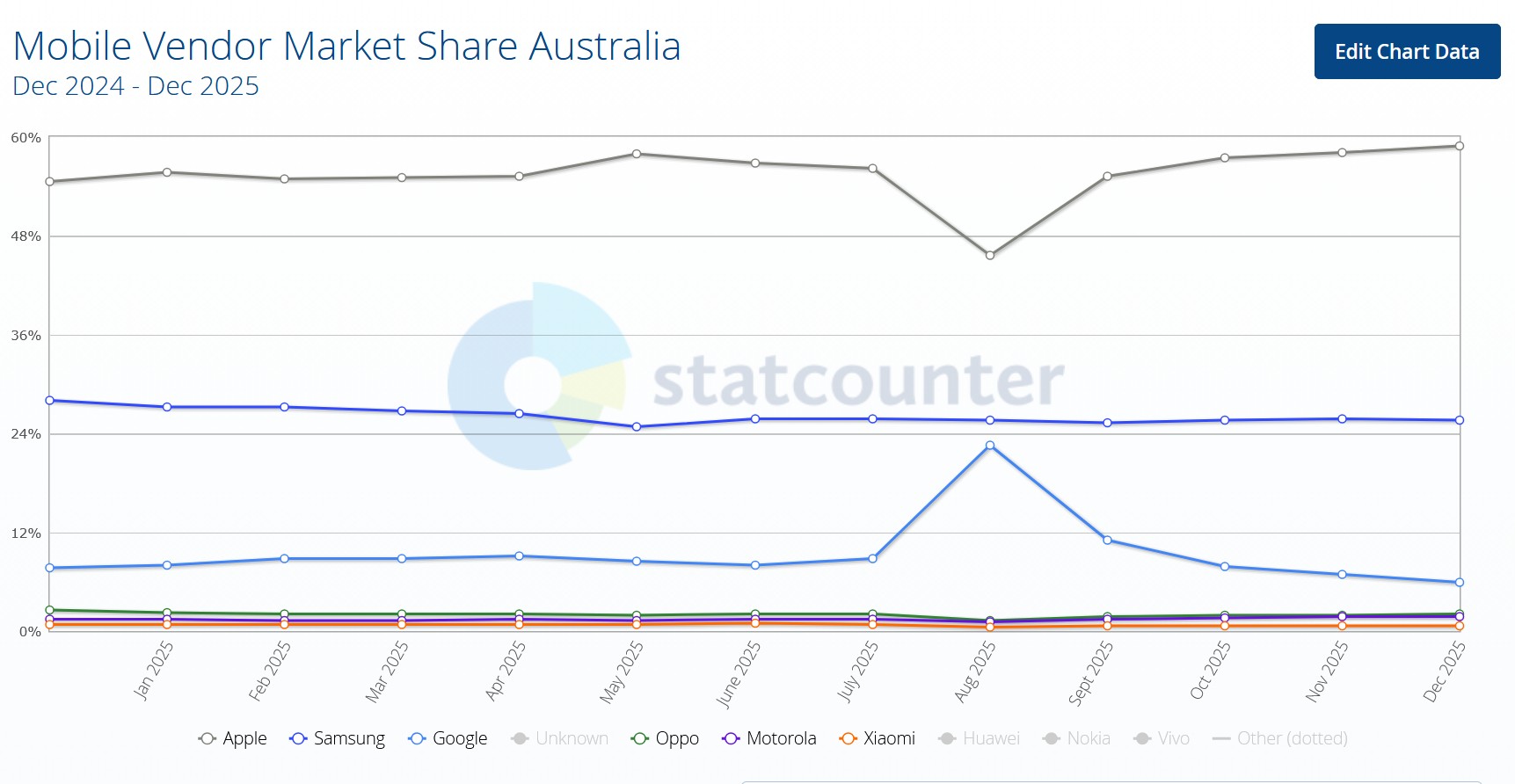
- Apple finished the year at 58.83% (lowest August 45.62%)
- Samsung at 25.57% (stable)
- Google at 5.87% (peaked at 22.53% at the August launch, stealing sales from Apple)
- Oppo 2.01%
- Motorola 1.74%
- Xiaomi .67%
The overall makeup is iOS at 55% and Android at 45% (approx).
Why is Australia so different?
Global trends are different to Australian trends because we really only have Apple, Samsung, Google, OPPO, Motorola and a handful of niche players like Nothing, TCL, Xiaomi, and now Honor.
Why is Samsung #1 in Android?
While Samsung’s premium Flip and Fold and Ultra phones are selling well, its bread and butter is the A-series – good, reliable phones with the same 2+7+7 Warranty, OS Upgrades and security patches.
Samsung has developed its own ecosystem and Google app substitutes, which kind of makes it harder to move to a different brand. Plus, it’s hard to beat their reputation, marketing budget and retail availability.
Google is #2, and its market share is because it has managed to demystify AI and make it all about how it can help you. The hardware (made by Foxconn) is solid and does the job. The Google Pixel 10 Pro XL: More brains than brawn has the best camera prowess, only challenged by OPPO’s Find X9 Pro. Looking at the graph above it stole enormous market share from Apple between July and October.
OPPO (One Plus) and vivo are part of the BBK group, and while fierce competitors, they share most of the technology and supply chain economies. They each have different markets and strengths. Vivo is remarkably strong in India, and OPPO in Europe and Asia/Pacific. Combined, they exceeded Xiaomi as the world’s second-largest smartphone maker. In Australia, they are now #3 behind Samsung and Google. They have tightened their range to the premium OPPO Find X9 Pro: Simply the best, mid-range OPPO Reno 13-series – the right one for you and its lower cost A-series.
Motorola is the try-hard #4 and has adopted a strategy of a phone in every niche. I can’t fault them, and its Edge 50 Pro – an excellent upper-mid-range smartphone was our 2024 phone of the year (and frankly beat every 2025 contender too).
Xiaomi is a new brand here and is not only selling phones but wearables, smart home, robot cleaners, stick cleaners, cameras and much more. Its market share reflects the process of building awareness, gaining distribution (Harvey Norman is the only approved retailer) and stamping out a massive grey market. Do not buy on marketplaces, as these are not certified for Australian networks, and you may get a notice that they cannot dial 000. In that case, you have wasted your money.
Replacement cycles will extend
The average replacement period post-COVID was two years. That has slipped out to 3.36 years for mid-range and premium phones. That may slip even further in 2026 for four reasons.
- Economic uncertainty: Food, rent and the necessary costs of living have skyrocketed. Analysts say that it will cost $2,000 more per person in 2026 for the same standard of living as in 2025.
- Phones tipped to rise at least 15% and more for premium specs.
- Most phones now come with 5-year (or longer) batteries, and they are more repairable, meaning a battery for an iPhone 15 is now about $100 instead of $400.
- Recycled phones are picking up market share, estimated at 2% and may grow to more than 10% by 2030. Smartphone makers and Carriers are offering trade-in programs, which provide for the growth in this area.
AI. Friend or foe?
I see an increasingly deeper divide between AI and non-AI users. To be clear, I am not talking about on-device AI that helps take better pictures or translates text and calls, but about generative AI like Google Gemini, ChatGPT, Perplexity, Copilot and now Apple’s Siri will be based on Google Gemini. Or worse, country-specific AI like China’s Deep Seek.
Put bluntly, AI phones need at least 16GB of RAM (the current crop of 12GB will soon be inadequate) and fast, reliable 5G mobile data. Let’s not forget that this AI will come at a monthly cost. Given the RAM price increase, we will see phones being categorised as smartphones or AIphones.
My take: Premium AI models like the Samsung Galaxy S25 Ultra (and its successor) will be less appealing to those simply wanting a good phone. There is a new opportunity in the mid-range $500-1000 market.
Phone outlook for 2026, Phone outlook for 2026, Phone outlook for 2026, Phone outlook for 2026