
The Government has released information on its Cheaper Home Batteries Program. This post outlines the rebate criteria and helps you assess whether installing a battery is worth it.
Before you read on, I’mTech has amassed considerable expertise in rooftop solar. If you are considering solar, you might like to read Parts 1, 2, and 3.
Cheaper Home Batteries Criteria
- You must have rooftop solar panels, although the legislation does not specify the kWh generation capacity. There is no point in paying for a battery if you can’t charge it, e.g., exporting at least the battery capacity each day.
- Minimum battery size is 5 kWh (kilowatt hour) and maximum is 50 kWh.
- A battery system and the inverter must be listed on the Clean Energy Council (CEC) approved Battery product list and Inverter list.
- The battery must be installed by a person accredited for battery installations by Solar Accreditation Australia (SAA).
- Rebates are based on the new kWh usable capacity.
- NSW has cancelled its battery rebate scheme. The NSW VPP scheme still operates for >10 kWh batteries.
- A battery system (including an inverter) installed on-grid must be VPP-capable. Many existing inverters are not.
How much is that worth?
Each STC is worth $40. For example, a 5 kWh battery x approximately $372 = $1860 rebate. The rebate reduces annually over the scheme’s life. The consumer cannot buy a battery outright, only get an installed price, so it likely will not reflect the full discount after install and administrative costs are included. To be clear, you probably won’t receive anywhere near 30% of the battery cost.
| Year | 2025 | 2026 | 2027 | 2028 | 2029 | 2030 |
| Estimated value per kWh | $372 | $336 | $296 | $260 | $224 | $188 |
| STC factor | 9.3 | 8.4 | 7.4 | 6.5 | 5.6 | 4.7 |
What is the VPP issue?
Battery systems installed on the grid must be on the CEC-approved product list and able to be coordinated through a virtual power plant (VPP).
This includes the ability to connect to the electricity grid, respond to signals from third-party VPP operators, and maintain an ongoing internet connection. That capability may include a new inverter and other requirements to be met to participate in a VPP, even if you choose not to.
While it is not mandatory to join a VPP, the fine print states:
Additional requirements may be developed to ensure ‘VPP capable’ reflects technical and consumer expectations over time.
That is double-speak for potentially making VPPs mandatory if you have a battery.
According to the recent data from SunWiz, consumers remain unconvinced, with most VPPs currently registered with the AEMO to provide grid services remaining small, while others have gone backwards or been wound up.
Read VPP – Beware of the solar battery trap
Other costs
Currently, door-to-door hawkers and call centres are selling a new 5 kWh (or more) battery system on the basis that you get a 30% discount from the government. My neighbours have solar panels but no battery, and have already turned away five hawkers.
They like to play games with the hawkers and know that their system is not battery upgradeable without a new inverter and cabling, and they don’t have internet. They also know that the battery must be at least IP69, marine environment rated, and use LiFePO4, not Lithium-ion.
The cowboys all say there is no problem. Sign here!
You should consider your options and compare the benefits and costs of installing a new or expanded system. This includes:
- Electrical wiring upgrades
- Compliance with current standards
- Operating efficiency
- Hidden costs of changes or upgrades
- Impacts on feed-in tariffs.
- Battery quality – do you want a 5, 10 or 15 usable life?
- Environmental issues
If you are expanding a system, you may need to replace or upgrade components of your system to participate in the scheme. If you have previously received STCs, you are not eligible for additional STCs for replacements.
Batteries are not all the same
The CEC list includes about 600 brands/batteries/models and variants. It includes batteries whose approvals will expire in 2025. It does not discriminate between Lithium-ion ‘bombs on the roof’ and the vastly safer Lithium Iron Phosphate 4 (LiFePO4). Nor does it specify battery life, guarantees, IP ratings, or whether the batteries can be used in marine environments.
But a hidden issue is how that battery works. For the most part, the battery app does not speak to the inverter app—it is a dumb fuel tank. Having an app that covers the whole system is a huge advantage.
Is it worth it?
Let’s assume that a 5 kWh battery costs about $5,000 after the rebate. We won’t account for finance costs, and paying extra for inverters, etc.
Now, 5 kWh is DC, and that needs to be inverted into AC. Most inverters are around 80-85% efficient, so you get 4000 watts for an hour, which might run your home with a fairly meagre 500 to 1000 watts/hour base load for four to eight hours overnight. Base load is how much energy you use, such as lights, fridge, TV, etc., and excludes cooking appliances, cooling/heating, hot water, and washing /drying.
Call that your fuel tank. Energy when the sun shines to fill it is free, but energy from the grid is damned expensive.
The following figures are based on selling 4 kWh (the entire AC battery capacity) to the grid every day at 5c per kWh. At that rate, it would take 68 years to pay off that battery!
The real value of a battery is its use in a blackout or when the sun does not shine. It means you are using them mostly when you would pay peak and shoulder rates. In NSW (these are Origin Energy prices), the time of day peak rate is 65 cents per kWh, shoulder is 35 cents, and off-peak is 27 cents. Then there is the totally unavoidable $1.12 daily supply charge.
- Off-peak payback: 12.68 years
- Shoulder payback: 9.78 years (typical battery life is 8-10 years)
- Peak payback: 5.27 years
Energy prices will continue to rise, but the dynamics won’t change much.
To summarise, you pay $5000 for a battery, and if you sold its entire storage every day, you would never make a profit before it reaches the end of its life. If you look at the current economics, you will never buy a battery.
Why buy a battery?
I guess I am asking this to justify my installing 10 kWh of batteries at an approximate cost of $15,000 .
- Backup for blackouts: The batteries have about 10 hours of base load. If I just ran the fridge/freezer, I may get 24-30 hours. ✅
- Clean electricity: The pure sine wave from the Enphase microinverters is better for my equipment than the dirty AC grid power. ✅
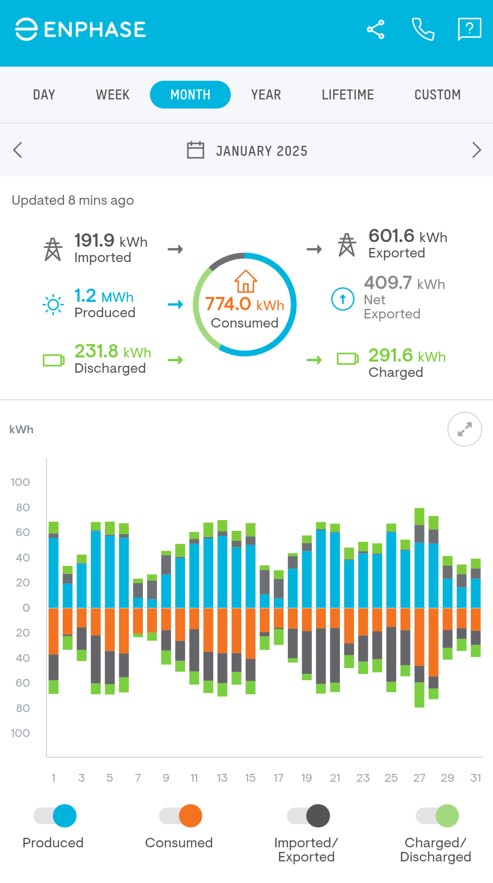
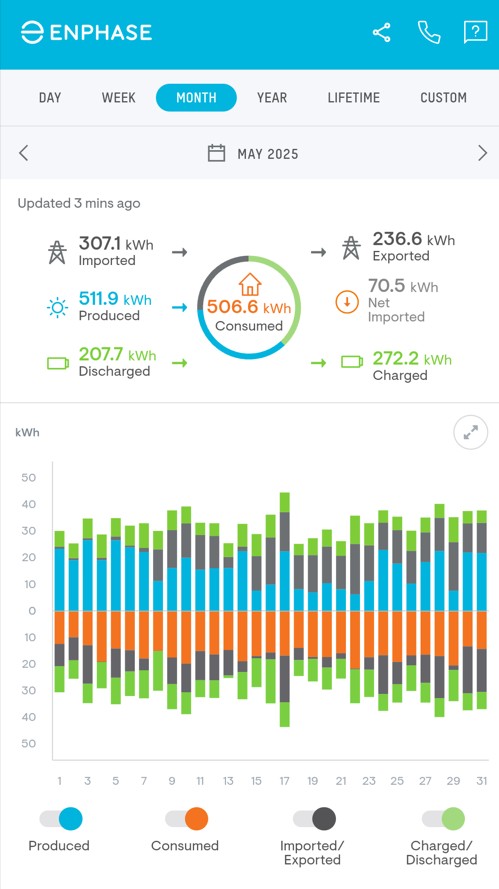
- Environmentally conscious: It helps to reduce carbon emissions. So far this year (five months), I have reduced C02 emissions by 3.6 tonnes and sent 2.4 mWh (2400 kWh) back to the grid (at a lousy 5 cents or $120 for 5 months). ✅
- Feed-in tariff: At 5 cents per kWh, that is a big, fat❌.
- Night use: To save about $5 for overnight use (and that is closer to 10 kWh), that has a payback period for me of 8.2 years. ❌
- Self-Sufficiency: To eliminate grid energy, I would need 15 kWh of batteries, but they would still charge $400 per annum for the daily supply charge, and an extra 5 kW battery payback would be 7.8 years ❌.
- Charge an EV (which I don’t have): A Tesla Model 3 has about a 50 kWh battery for about 500km (some are up to 100 kWh) and takes about 8 hours to charge at 7 kW per hour. Charging it during the day from solar power is no issue when it is sunny, but at night, it would exhaust the 10 kWh batteries in less than two hours ❌.
What it confirms is that unless battery technology radically improves and costs come down or grid electricity prices increase beyond comprehension, the payback time is going to stick around 10 years. ❌
I’mTech’s insight: The Cheaper Home Batteries Program won’t be of great benefit to anyone
Sure, it is nice to get a battery a bit cheaper, but you really need to do your sums and understand your energy use before you outlay the big bucks.
If you are a small household and only have a low baseload of 500- 600 Wh (to run lights, fridge, and TV at night), your payback will be longer than the battery life.
If you are a large user with a baseload of 1- 2 kWh, you will get marginally faster payback, but you will need more batteries.
If you are an energy hog and run a ducted AC system, you could be using an extra 4- 5 kWh every hour. You would need 60 kWh of batteries just to do that.
Of greater concern is that the Cowboys are already hard-selling and using completely fabricated figures to win over people.
Confused – I was
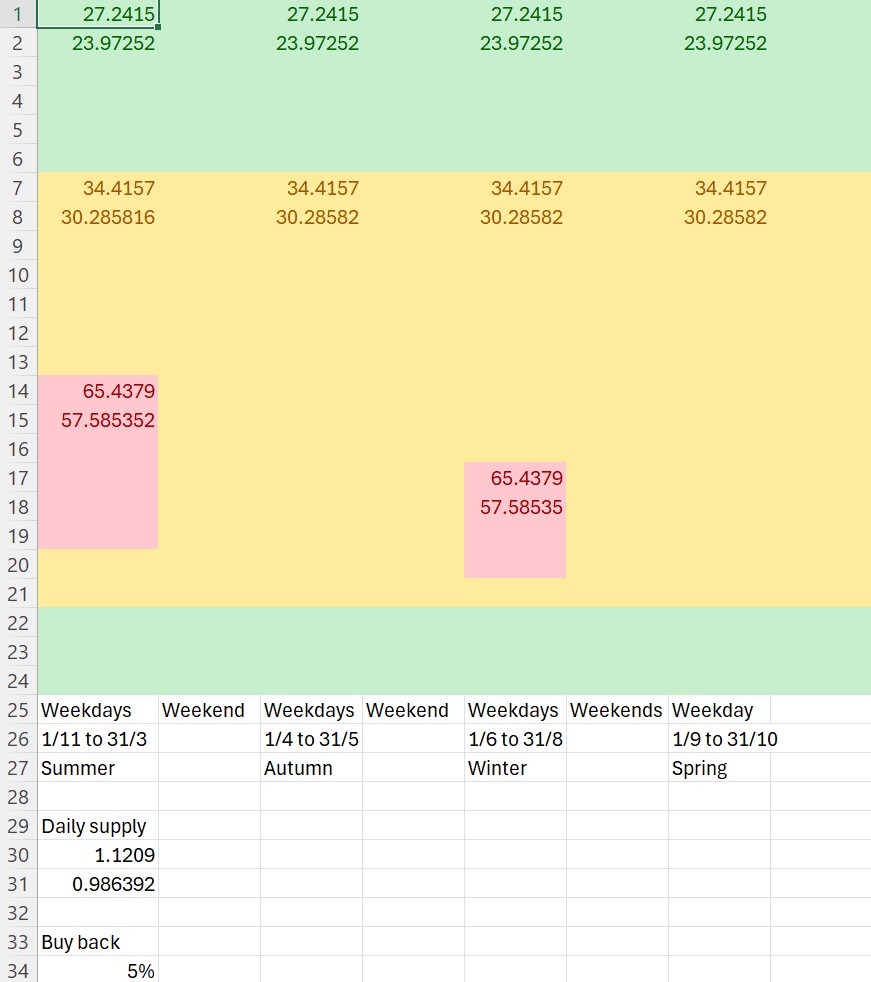
There are so many schemes and different tariffs that it is almost impossible to compare (and don’t get me started on those shonky comparison sites). I tend to be a visual person so I simply used Excel to visualise the tariffs – it took minutes.
Down the left side, 1 to 24 is the time from 01:00 to 24:00.
The green is for off-peak tariffs, yellow for shoulder and red for peak. The top figures are the recommended base rate, and under that is the discount offered for 12 months.
Finally, this is broken into columns – Summer, Autumn, Winter, and Spring and weekdays and weekends. ‘Simples’ as far as I can kick those bloody meercats.
When you install rooftop solar, you start to understand that energy-hungry appliances like washing machines, dryers, and dishwashers should be put on after 10 PM because they will use whatever is left in the battery, and then the off-peak rate. If you need to recharge the battery due to rain or overuse, do it after 10 PM because 10 kWh only costs $2.70 ($2.30) versus $6.50 at peak rates.
Cheaper Home Batteries Program, Cheaper Home Batteries Program, Cheaper Home Batteries Program, Cheaper Home Batteries Program, Cheaper Home Batteries Program
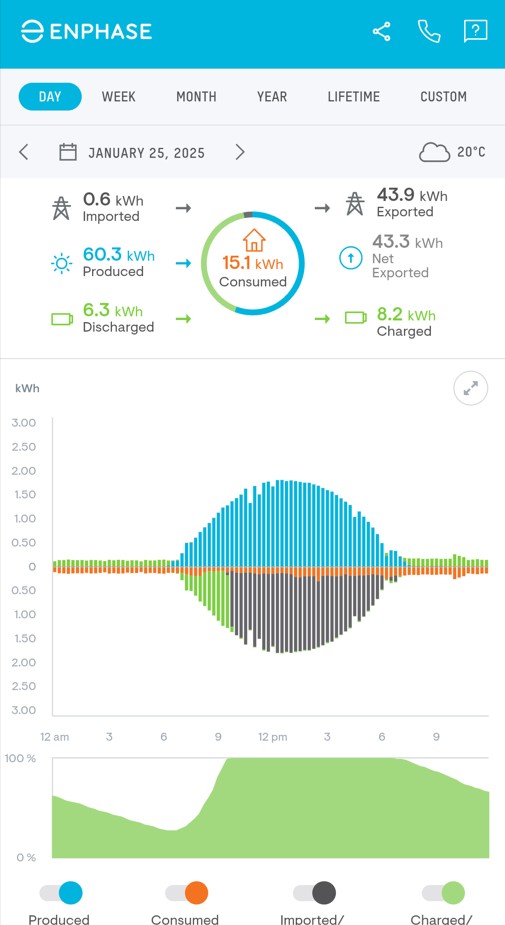
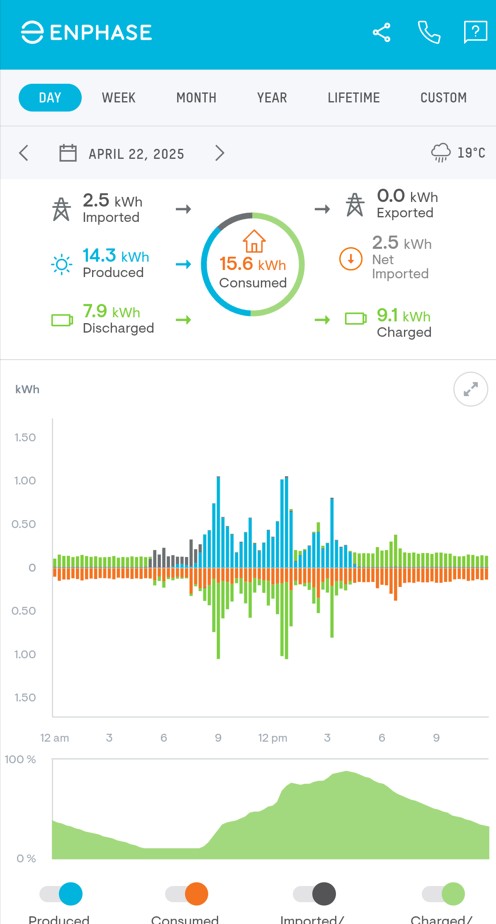
Rooftop solar owners should look at their app regularly to see what rooftop solar is doing