
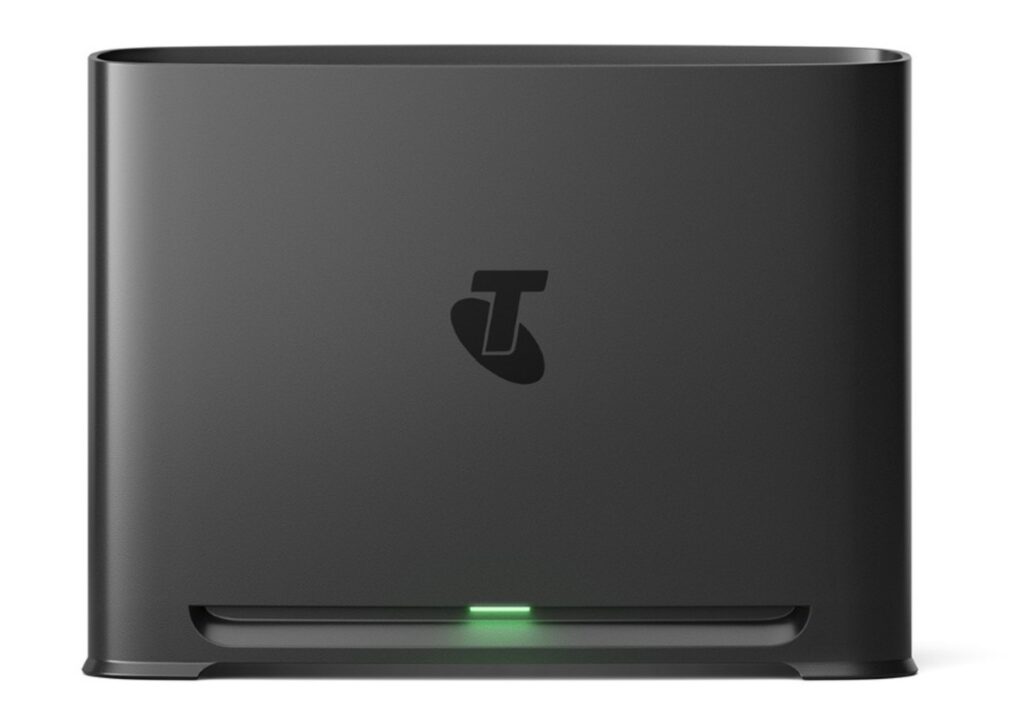
The new Telstra Smart Modem 4 is Wi-Fi 7 and 5G fallback capable, but this is simply marketing hype that covers up the fact that this is still a very crappy modem router.
We will update this as we get more information. The I’mTech community is working.
Update: 28/8/25
Reader Will has disassembled his and advises
- Sagemcom Model FAST 5988TA V2.1 (no results on Search)
- 1x Quectel RG650V-TL (4/5G)
- 2x Qualcomm QFW7114 (No details on search – likely the CPU and Wi-Fi chip)
- 1x REALTEK RTL8367S (4-port 100/1000 Switch)
- 4 x internal Wi-Fi antennas connected with u.fl connectors on the motherboard (This means 2 x 2.4 GHz and 2 x 5 GHz, which have to support Wi-Fi Rx/Tx and mesh satellite forward and back haul).
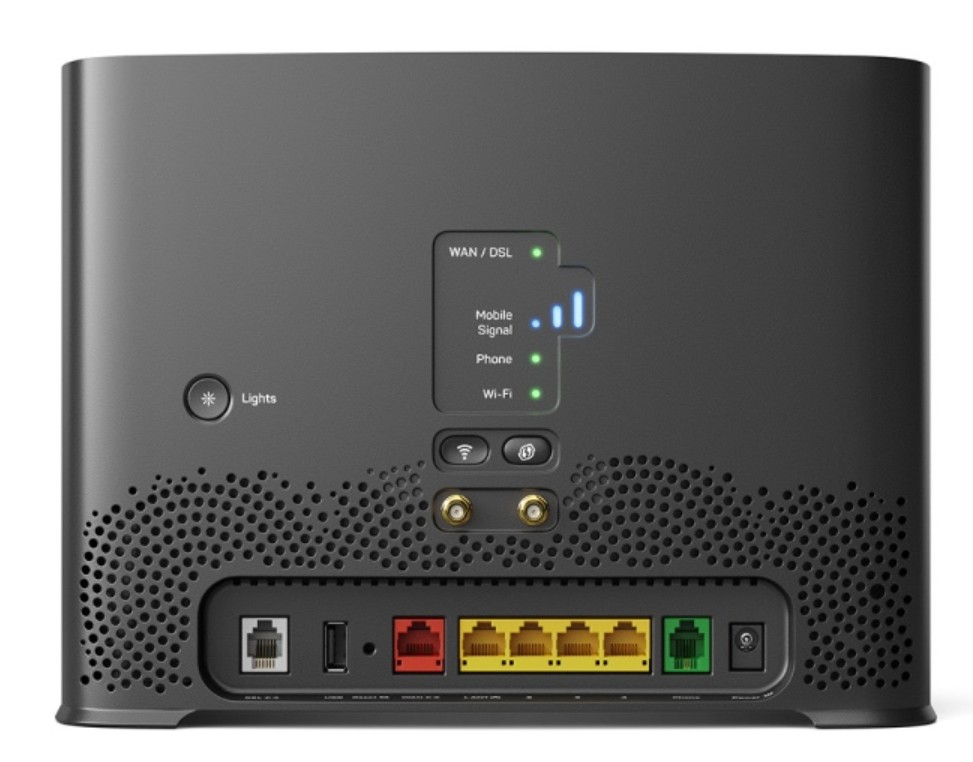
- 2 x internal LTE antennas on the PCB, with external u.fl’s to SMA connectors on the back of the case. There was an ‘internal’ or ‘external’ antenna option in the settings.
- 1x WAN (magnetics: G24107MN-R) Confirmed as 100/1000
- 4x LAN (magnetics: GST5009BM) Confirmed as 100/1000
- Full teardown here.
Update: 30/8/25 – Huge issues with WPA3 – have to disable Wi-Fi 7
Reader Jeff writes that older WiFi devices that use WPA2 or WPA (not WPA3) require the modem to be crippled. After hours of trial and error, and Telstra support:
- Wi-Fi settings
- Turn Wi-Fi 7 → OFF
- Change Wi-Fi mode → Wi-Fi 6 (2.4/5 GHz)
- Set channel bandwidth → 20 MHz (not 20/40 MHz)
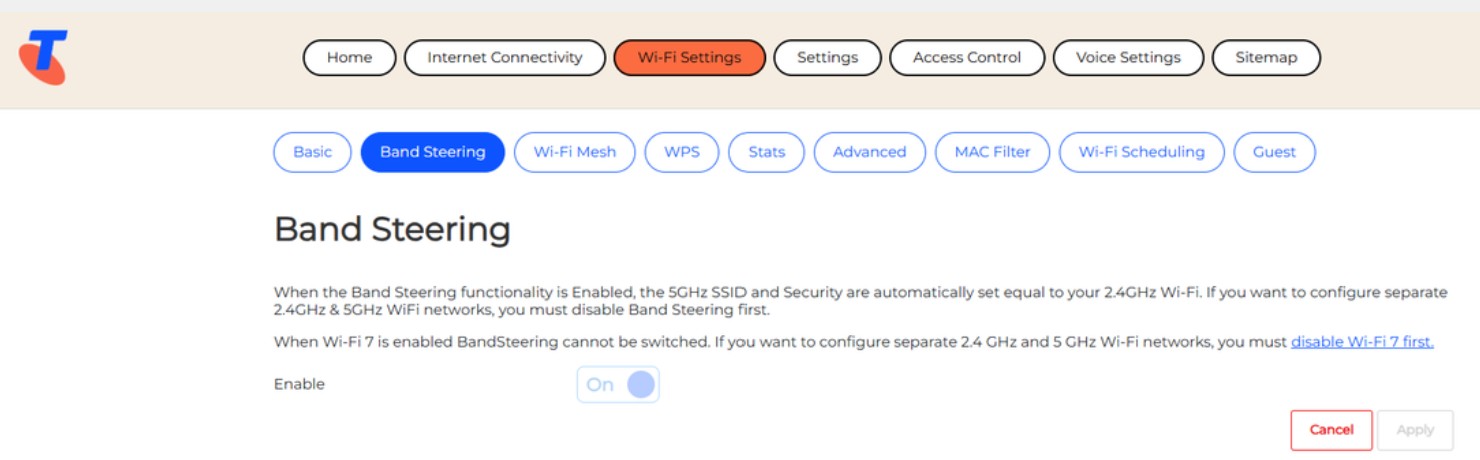
- Disable Band Steering (no MLO backhaul)
- Separate Wi-Fi bands
- Rename 2.4 GHz and 5 GHz Wi-Fi so they have distinct names (e.g. HomeWiFi_2.4 and HomeWiFi_5)
- Connect devices
- Printer must connect only to the 2.4 GHz Wi-Fi
- Other devices (such as iPhone, iPad, and computer) must also be on 2.4 GHz when printing.
This effectively makes the SM4 slower than the SM3!
What is wrong with the Telstra Smart Modem 4?
Way too much. For starters, its performance is no better than a Wi-Fi 6 modem, and it does not have a 6 GHz band. WTF?
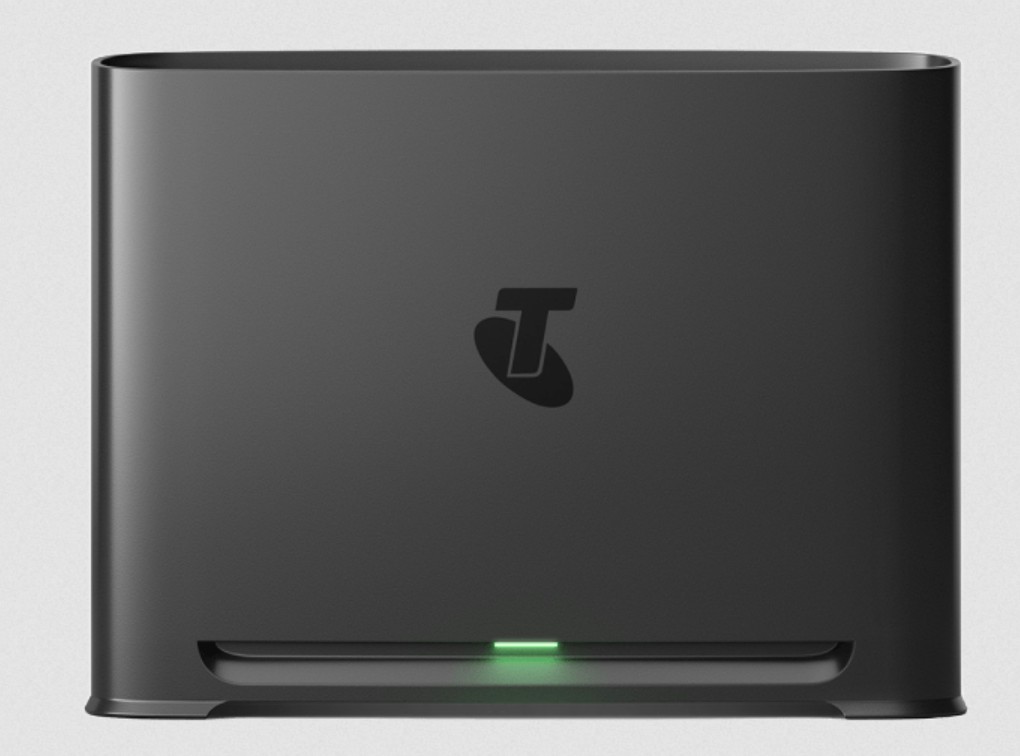
It is big
25cm (L) x 6cm (W) x 19cm (H)
Telstra can remotely disable it
Reddit has reported that it can be remotely disabled for non-payment.
Telstra refuses to reveal the BE speed
Most modem manufacturers quote a speed, in this case BE, and a number. We suspect it is BE3600 or 2.4 GHz 688Mbps and 5 GHz 2882Mbps. This is really slow.
Even if it’s BE5000, it only gives you 5 GHz 4324 Mbps, of which half is dedicated to satellite backhaul.
It is dual band – 2.4 and 5 GHz – no 6 GHz at all
Wi-Fi 7 is all about tri-band – 2.4, 5 and 6 GHz. Without three bands, much of the go-fast Wi-Fi 7 technology is limited.
If you Disable Bandsteering, you disable Wi-Fi 7 features
If you want to have a separate 2.4 GHz and 5 GHz SSIDs (necessary for a lot of IoT devices), it disables Wi-FI 7 ‘go-fast’ features, including MLO. This can have a terrible impact on Wi-Fi backhaul.
It does not support 320 MHz bandwidth.
- 2.4 GHz band has 10/20/40 MHz bands for a maximum connect speed of 466 Mbps
- 5 GHz band has up to 160 MHz for a maximum connect speed of 2402 Mbps
- It has 1024 QAM, not Wi-Fi 7 4K-QAM.
Wi-Fi 7 can connect at 5804 Mbps (6 GHz 320 MHz), but not this modem!
It has a 10/100/1000 Mbps WAN port
It won’t support the new NBN speeds over 1000 Mbps. Where is the future-proof 2.5, 5 or 10Gbps WAN port?
It has 4 x 10/100/1000 Mbps LAN ports
It won’t support 2.5, 5 or 10 Gbps Ethernet backhaul, which is really important for mesh and Wi-Fi hogs!
Only USB 2.0 – Why not USB 3.0 5Gbps?
This is a pathetically slow 480Mbps (60 MBps) half-duplex, so the maximum speed you can get is about 30 MBps for file sharing.
Wi-Fi mesh is pathetic
We don’t have any details on whether there will be a new Smart Booster 4, but any mesh over dual-band will result in slow and unreliable performance. To be clear, it will take about half the 5 GHz bandwidth for satellite backhaul, leaving little for your Wi-Fi devices.
5G fall back – a farce
So few users get a strong enough 5G signal that, for most of the time, the modem will be hunting for 4G band 28 or Band 3. The maximum speed, regardless, is 25/5Mbps. They put in an eSIM capability so that they don’t have to report to the ACCC the frequency of hardware outages – you still have some Internet access.
But Telstra don’t tell you that most of the time you can’t get a 5G signal indoors and very poor 4G signals at best. It has dual external SMA antenna ports, but the cheapest Telstra-certified dual-band 4/5G antenna is around $500 plus cabling and fitting!
It is made by Sagemcon in China
It is a Mongoose-5GFW, but don’t look for that model name as Telstra makes it up. We were informed that Technicolour made it, but a reader says it is Sagemcom. Its pedigree is not so important as the model number. Now confirmed as Sagemcom F@ST 5988TA V2.1
Note: It is not the Sagemcom F@ST 3897T as suggested on Whirlpool. Model details to come.
In our experience, the Telstra Smart Modem 3 – not all that smart or fast (update after test – network review) accounted for the majority of dropouts, which magically stopped by replacing it with a better modem.
Telstra still uses a proprietary voice protocol, so you can’t use this modem for a landline on another NBN network.
Designed for all types of Internet
It supports Ethernet and VDSL WAN types. The Quad-core ARM Cortex-A55, 2.2GHz processor is adequate, but it is pretty limited with 2GB LPDDR4 RAM. This is not for heavy users or gamers.
The claim that it supports up to 250 Wi-Fi devices is laughable
Telstra is simply quoting the IP range, which is 1 to 256, in a subnet.
Assuming these were primarily 2.4 GHz IoT devices, you may get 30-50 active devices. Far less so if you have Wi-Fi security cameras and video doorbells that need closer to 5 Mbps for HD and 25 Mbps for 4K. Add in a Wi-Fi speaker system and a couple of 4K TVs for streaming, and it is closer to 10 active devices. To be fair, Telstra is quoting ‘up to’.
FAQ
There is no downloadable manual.
FAQs are very limited.
Cost – not worth it
You can buy it outright for $240 or $20 or $10 per month on 12- or 24-month plans. Existing Smart Modem users are not offered a free upgrade.
Yes, it has 4/5G fallback, works on FTTN and FTTC and has a proprietary voice port, but it is not Wi-Fi 7 tri-band. It does not have a DECT chip for handset connections.
I’mTech’s insight: Telstra Smart Modem 4 is the quintessential crappy NBN modem
I can’t understand why Telstra persists in lying by omission. If it revealed its true specs, consumers would have a choice. But no – it wants to lock you into expensive NBN and crappy hardware.
Even if you are a rusted-on Telstra user and have an Ethernet NBN connection, I can think of several lower-cost routers that would eat this for breakfast. Look at the TP-Link Deco mesh BE65 or BE65 Pro Wi-Fi 7 tri-band 2.4/5/6 GHz BE11000 (three times as fast), seen as low as $368!
Whatever you do, there are far better and lower-cost NBN providers and hardware out there.
Read
- Got a Wi-Fi problem but not much cash to fix it?
- NBN switching – tired of Telstra, Optus and Vodafone?
- Seamless whole-of-home Wi-Fi is easy with Wi-Fi 6/6E/7 (2025 update network guide)
- Crappy NBN Modem – here are a few better ones (2025 update network guide)
Telstra Smart Modem 4 , Telstra Smart Modem 4 , Telstra Smart Modem 4